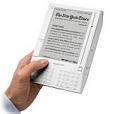
 I've started another blog, E-readerworld, to focus on news of other e-readers since I'm interested in the technology in general but some Kindleworld blog followers prefer the focus on mainly the Kindle. Among other e-readers there, I've started following the Kobo, since it's due here in June and is partnering with Borders.
However, it seems there can't be a day without dozens of columns saying what new device now WILL (finally) kill the Kindle, since it seems to be a bit harder to kill than had been thought (wished ?). Maybe it would help if some writers even read about the features of each device and compared those. Before the money is put down, most consumers do comparison-shopping.
This won't be about those strange columns though.
However, even Consumer Reports' Paul Reynolds, in an otherwise neutral article, feels the Kindle will need to reduce its price again to approach the Kobo pricing because it's felt Amazon needs to be more competitive with other e-readers even when they don't have many (basic) features the Kindle has.
Whatever happened to the idea of features-comparison?
UPDATE - 5/10/10 - 11:14 AM
I just saw that Paul Reynolds made a gracious reply to my comment to him at Consumer Reports. Part of my concern had been that probably 99% of the online articles on this topic cite, at best, the wireless feature (and that there are costs associated with it) but don't mention the many reading-associated features that one model has that the less-expensive one doesn't and which I feel people should read about when price difference is the key focus. The explanation Paul Reynolds gave was very well stated. [End of udpate]
As an e-reader customer I wouldn't mind any price decreases.
But, should all models with varying features, say, by one manufacturer be priced as if they were nearly the same? Each added feature brings more cost. That's probably as old as the first humans on the planet.
The underlying thought by many technology reporters about e-readers seems to be that any device that is "just" a book reader has to be of very low value. I've seen that in many stories - that the pricing should be $50 or $99 at the most. Some of it comes from research in which people were just asked at what price would they consider an e-reader. Counted are those who wouldn't even particularly want one.
Mashable's Lauren Indvik writes that "The Kobo e-reader is very similar to Amazon’s Kindle 2 both in functionality and in appearance, but at $150, is almost half the price."
I added a comment to the "very similar...functionality" description.
"Actually, the Kobo e-reader is not very similar to Amazon’s Kindle 2 in functionality unless you count only showing the text on an e-ink display.Well, that's my bit for the current onslaught of articles about the Kobo as "Kindle Killer" - a term much loved by the media for some reason.
Here's what is part of the Kindle functionality but not at all present in the Kobo:
[ I've separated the features by lines here. ]
. an in-line Dictionary
. a Text-search mechanism (for the book or the device)
. the ability to Highlight or make Notes
(and to see them automatically organized and viewable
on a private webpage if wanted)
. the ability to use 3G wireless and at no added cost, 24/7 in the States
. the ability to use Wikipedia via 3G globally for free
while reading a book and wanting to know more about
a word or phrase or a character in the book.
*Less important functionality* that the Kindle has but the Kobo doesn't:
. Text-to-speech on any documents, periodicals, or books while busy
w/other things but wanting to continue 'reading'
. the ability to listen to mp3's in the background.
The Kobo can't use WiFi networks instead [of 3G celluar], as the Nook does.
However, the Kobo does have the Adobe licensing to use the public library and if your local library 'Overdrive' program has a lot of good e-books, that's worth quite a bit. [ It also reads ePub files.]
Too many are looking only at price (which isn't done normally because you usually have cost-comparison of features),
With the Kobo and its $149 - you get what you pay for, bare-bones functionality. For $110 more, the Kindle gives a lot more long-term value. That free 3G access for mobile-text webbing is useable anywhere, including when in a bus or in some waiting-room somewhere.
The Kobo has neither 3G wireless nor WiFi - it's actually quite limited for $149. [Bluetooth transfers can be relatively cumbersome.] BUT I recommend it for the public library access for some, though that depends on what the local library stocks in the way of e-books and how many can borrow one at the same time..
Amazon has 20,000 or more free books, easily downloadable 24/7 from anywhere. The Project Gutenberg's 30,000 files can be downloaded directly to the device over the air at no cost via the "Magic Catalog."
WORD doc files are accepted by Amazon for free conversion to Kindle format, which is very helpful, but these can also be done [converted] by the user.
Also, the 16 shades of gray [Kindle] vs 8 shades [Kobo] can make quite a difference in photos."
See the ongoing Guide to finding Free or Low-Cost Kindle books and Sources
Check often: Latest temporarily free non-classics or late-listed temporarily free nonclassics.
Also, a prepared links that confine searches to mid-range priced e-books.
