Showing posts with label border's kobo. Show all posts

Consumer Reports releases new ratings report on E-readers - Update

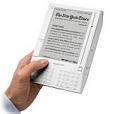
Consumer Report has released its latest survey of e-readers, and they have the Kindle at the top again.
  Click the image at the left to see the video.

 The video linked to at the left explains that the iPad was not included because they were testing the category of dedicated e-readers and the iPad is essentially a multimedia tablet and computer that also functions as an e-reader.
  They add that it's considerably more expensive while having an LCD screen which "is fine, though it is slightly less crisp than that of the best e-book readers" and is also quite a bit heavier than the dedicated readers they test and portability was a feature important to the set.  "Consumer Reports recommends buying the iPad for e-books only if consumers are willing to compromise to get a multifunction device."

Consumer Reports has its full story and ratings behind a paywall, but KABC's story on the CR report has a few quotes:
' "I'd say the color screens are almost impossible to read outdoors," said Rich Fisco, Consumer Reports.  "On the other hand the e-ink screens are almost like reading a real book."

In the end, Consumer Reports gave top ratings to the 3G Kindle, which costs $189.

"It's the best reader we've ever tested," said Paul Reynolds, a tester with Consumer Reports. "The type is crisp and easy to read. The battery life is outstanding, as is the speed of the page turns."

But you can save money buying the $139 Kindle, which is identical to the 3G except you can only download content via Wi-Fi.'

  Amazon Kindle forum regular Fool for Books points out that the Amazon Kindle Community Forum has had many notes from customers who had to upgrade their $139 WiFi only models almost immediately because they had not understood that in order to use 'wireless WiFi' in the home when one doesn't have the 3G cellular wireless feature (which all past Kindles have had), they had to have set up a WiFi network in their home -- which itself also brings expenses, while the top model with 3G cellphone-type wireless carries no additional costs for even the added feature of looking up info on the web, in about 61 countries) from almost anymore.

  See the blog article on differences between 3G/WiFi and WiFi-only access.

  Consumer Reports also recommends the Barnes and Noble Nook. "It doesn't score quite as high as the Kindle, but you can use it to download free library books.  The Kindle doesn't accept library books," said Reynolds."

I subscribe to Consumer Reports online and it's really worth the $26 or so per year as you can search it.  On the Recommended readers, there were these interesting comments and scores (excerpted):
' Best choices for use everywhere:
Amazon Kindle 3G + Wi-Fi -- 72
The best e-book reader we've ever tested, and one of the lightest and slimmest.  Superior page turns and the most readable type we've seen.  A jumbo font size and text-to-speech capability are boons for the sight-impaired.  Among the few models that doesn't support library rentals, however...

Barnes & Noble nook 3G + Wi-Fi -- 56
Though among the more challenging devices to use, due in part to its dual screens, it's also among the highest-scoring models that allow e-book rentals from public libraries, a potential cost-saver...

Best values
...you can load new content wirelessly only via Wi-Fi. These versions are better buys than their pricier siblings, unless you expect to frequently need new content when you're out of range of a Wi-Fi network.

Amazon Kindle Wi-Fi -- 68
[Same description as for the 3G-included model above]

Barnes & Noble nook Wi-Fi -- 53
[Same description as for the 3G-included model above] '

Consumer Reports always neglects to mention that the 3G on a Kindle allows you to use Wikipedia or to look up info anywhere on the Net, from your book, when on a bus or at the park or beach or at the dentist's office :-) etc...and that the now 3-yr experimental Free 3G Web Browser that does not confine you to the company store (nor carries a charge for web lookups) differentiates it from the other models to a considerable degree ... not to mention that it's WebKit based and faster than the earlier browsers.

  Also, this 3G instant downloading of Kindle books is available to you in other countries when you're traveling -- in about 100 countries -- a unique feature of the Kindle since no other e-readers offer this -- and allows you free web access in over 60 countries.   I suppose this is considered a non-feature.  It amazes me that a serious comparison of e-readers is done without mentioning this.
' If you need a big screen:
This newest DX is suitable mostly for those with a large budget who plan to read a lot of textbooks, with large diagrams etc. it's a fine performer, with very readable type and page turns are only slightly slower than its fleet 6-inch sibling.

[Other e-reader scores in descending order]
    [The new Sonys were "In testing"]
enTourage eDGe -- 54
Pandigital Novel -- 50
BeBook Neo -- 50
Spring Design Alex -- 49
Aluratek Libre eBook -- 46
ViewSonic VEB620 -- 44
Kobo eReader -- 40
Augen The Book -- 40 '

The Kindles are the only ones with full red-circle 'Excellent' ratings for Readability.   For Navigation, they share that with the Pan Digital Novel.

From what I've seen in the news, the new Sonys will, after testing, wind up with best marks for Navigation due to its touch screen --  also, for flexibility of annotations, except that the Kindle annotations are backed up, and all your highlighting and notes are available to you on a private, password protected Amazon webpage, ready for not only viewing easily but also copyable for editing in a separate text file on your computer.

  That's invaluable for those studying a subject and needing to make reports.  It's also great for just reviewing the aspects of a book that were important to you or for use in discussing the book in a book club.  (You can also choose to disable backups of annotations.)

  The Sony with comparable features (though not free 3G web lookups) and the touchscreen carries a price about $100 more than the Kindle and Nook and is said to be very well made.


Kindle 3's   (UK: Kindle 3's),   DX Graphite

Check often: Temporarily-free late-listed non-classics or recently published ones
  Guide to finding Free Kindle books and Sources.  Top 100 free bestsellers.
UK-Only: recently published non-classics, bestsellers, or highest-rated ones
    Also, UK customers should see the UK store's Top 100 free bestsellers.

New Zealand gets the Kindle. Non-Amazon e-books for Kindle - how to get them


New Zealand is finally getting the Kindle 3
, according to this report by Stuff in New Zealand and the linked Amazon product page.

 The Kindle will be meeting Whitcoulls' Kobo e-reader head-on there, and the Stuff news reporter believes the company PR that the Kobo "appears to have a much larger range of e-books available; more than two million [books]," but this includes the 500,000 free Google Books and the 30,000 Project Gutenberg books.   The free Google Books are also available for the Kindle in two ways - see:

1. How to get a free Google book converted to Kindle format (for free, by the Retroread site, or with the flexible free utility Calibre), and also

2. check out how to download to the Kindle the Project Gutenberg Magic Catalog of 30,000 free e-books which allows Kindle owners to browse and search the catalog and then click to download what they want in Kindle's "MOBI" format (with no download charges in both cases).

  A thorough review of the Kobo is at Laptop Magazine, and what is unusual is that it will be more expensive than the Kindle while having no 3G or WiFi features, no built-in dictionary, no Search feature, no highlighting and notes and it is much criticized for being unusually slow, even for an e-Ink reader.  How this unit stays at all competitive now unless the company upgrades the unit is a real question.  Its website has a comparison chart that has not modified the Nook or Kindle pricing though they've been lowered for about 3 weeks.

Stuff has some good news for New Zealanders in that Martin Taylor, the director of the Digital Publishing Forum says the group expects to launch a digital warehouse that would let publishers manage and distribute e-books in the next few months.
  "We're working with about 40 local publishers who have put their hands up and I would guess hundreds, possibly a thousand, New Zealand books will be available [through the warehouse], {which will} broker with e-book distributors on behalf of publishers and the forum is in talks with several e-book retailers now, including Amazon and Whitcoulls.

Many other sources for free e-books direct to the Kindle at no charge are also mentioned at the Finding Free Kindle Books and Sources page, which I'll redo soon, as it's not well-organized for all the info that's there.  That info is on most footers of the blog articles here.


Kindle 3   (UK: Kindle 3),   DX Graphite

Check often: Temporarily-free late-listed non-classics or recently published ones
  Guide to finding Free Kindle books and Sources.  Top 100 free bestsellers.
    Also, UK customers should see the UK store's Top 100 free bestsellers.

Kobo Reader or Kindle - A follow-up as Kobo reaches Australia


About two weeks ago, I wrote a blog article on the press treatment of the new barebones Kobo reader vs the more capable Kindle because the vast majority of the articles don't mention the many reading features that the Kobo doesn't have while saying that the Amazon needs to compete on its price, going lower to match the Kobo.

  Actually, Amazon has needed to have a no-features reader for some time, as the Sony does, because some people really don't want or need anything more than the text from the books, at a doable price for them.  And the Kobo pricing is attractive.

  But that means reports comparing readers should mention the various reading features that are on one but not on the other.  For some reason, that's rare in articles on the Kobo vs Kindle.  They do point out that one doesn't have wireless downloads of e-books (it IS an expensive feature if via cellular wireless).

  Reading-features like the more basic study tools are important to some.
1. an in-line dictionary
2. searching of book for words, a character in a book, or an event
3. the ability to highlight and take notes and refer to them

See more feature-set differences described earlier.

  Those added features won't be important to others, which means the features do need to be discussed so that buyers know what they're getting (or not)  for the price asked if deciding between readers.

  Many want readers for their children, but for older students they may want the added study tools while not realizing that one reader doesn't have them.

  The ability to access, while reading a book, Wikipedia for more information at no added cost, globally, is not a small consideration for students.  As we've seen, the cost of 3G cellular wireless on an iPad is an extra $130 (on top of the $500 model)  for the capability plus $15-$30 per month.  So this is somewhat valuable for the extra $100 between the Kobo and the Kindle.

  Where the Kobo is very good for students or anyone is its ability, in the U.S.  to enable borrowing of e-books from public libraries which the Kindle does not do.   The Kobo also has an SD slot for expansion to allow more books to be stored, as its internal storage holds about 33% less than the Kindle.

  While I consider being able to listen, via the Kindle, to mp3's nice enough and feel that the text-to-speech for books, newspapers and personal docs can be useful for brief periods, I wouldn't look for them in an e-reader or consider them important.

 The latest articles do mention the worth of wireless access to books.
  In the U.S., Japan, Hong Kong and Mexico, Kindle users can also use google and look up text info from almost anywhere they are, though this is useful mainly at mobile-device optimized websites, as larger images are slow to load.  Amazon says it hopes to enable web-browsing internationally eventually, depending on regional telecommunication pricing arrangements they can get.

  Kindle owners who are U.S. residents, or are in the mentioned regions where the web browser is enabled, have access to the text of the full New York Times and several other newspapers, in mobile-device optimized format.
  Granted - it's not pretty at all, and gadget press have tended to call it "dowdy"-looking, but some actually don't mind reading mainly-words when wanting information and when there's no added charge for it and you can access it while sitting on a bus. 

  See the mobiweb entry for how that's done and for a file that provides the links in book-form.  This file works only with the Kindle though.

  There is a flood of Kobo vs Kindle reports especially from Australia, where the Kobo was recently released and I've been asked a few times for my take on the Kobo.    Here are two longer reports that are informative and balanced.

1.    Techlogg

      The report is from Australia where they have more limited wireless,
      so they can access only the Amazon store and Wikipedia.
' ...the jewel in the crown for the Kindle is its built-in worldwide 3G connectivity that allows users to buy books directly from the Amazon.com website without having to touch a computer or browser. What’s more, the 3G service is free. You don’t need to sign up for any contracts – you just activate it and away you go.

  The Kobo requires ebooks to be purchased via its webstore through a computer.
The Kindle 2 is more technically advanced than the Kobo but for those wanting to dip a toe into the ebook waters without having to deal with overseas purchases, the Kobo is going to be very hard to beat at its $199 [Aus., equiv $149 US] price tag.'

2.    APCMag.com News, another Australian news site
       This is a hands-on report with photos.
' Kobo lets you browse your personal library, choose a book, turn the pages and bookmark your place before you stop reading.  That’s as complicated as it gets, precisely because that’s as simple as it should be.  Like the original netbooks, Kobo is designed around pretty much one key task. '
  They point out that the feel of the unit is good but that the rubbery navigation button will be frustrating to southpaws.  That would be true of the Kindle's navigation button as well.
' But Kobo cuts some corners to keep the price down. The display shows only eight levels of grayscale (eight shades from white to black), so while the screen has decent contrast – especially in a well-lit environment – it’s not as ‘rich’ as Kindle’s 16-shade screen.

Page turning is also noticeably laggard, with each flip of the virtual page briefly pausing to show what looks like a photographic negative before the new page appears.  It’s a bothersome and distracting trait, especially when you turn pages twice as often as on a regular book (because you’re only able to see one page at a time on the screen).

The Kindle’s page-turn response is faster, snappier and less intrusive – evidence of a faster processor, superior operating system and/or display IO.

In addition to the inbuilt 1GB of flash memory, which Borders says can hold 1,000 typical books (one hundred public domain titles are preloaded), Kobo sports an SD card slot for adding thousands more titles to your grab-and-go library.

Publications in ePub and PDF formats (both open and DRM-protected) are first downloaded to your Windows or Mac system and then sideloaded onto Kobo over a USB cable or off the SD card.
Want Wi-Fi or 3G access to the bookstore so you can browse, buy and download on the move? Then Kobo’s not for you. But that won’t bother the bulk of consumers who are already comfortable using the same PC-centric approach for loading music into their iPods.
... as a starter, the $199 [Aus., equiv $149 US] sticker on this sweet, simple and rather stylish ebook reader could make the Kobo as hard to put down as any best-seller. '


 See the ongoing Guide to finding Free or Low-Cost Kindle books and Sources
   Check often:  Latest temporarily free non-classics or late-listed temporarily free nonclassics.