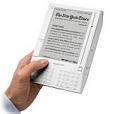
 INTERVIEW WITH AMAZON'S RUSS GRANDINETTI
The Los Angeles Times' Alex Pham gets some interesting responses from Russ Grandinetti, who is in charge of content for the Kindle (UK: K3).
After pointing out that Amazon currently controls 76% of the U.S. digital books market, Pham gives a brief history of the tensions between the publishing industry and Amazon's efforts to keep bestselling book prices lower, with a $9.99 or less standard that "infuriated a number of established publishers, who feared that digital sales would undercut the lucrative hardcover market."
Yes, think "The Big5" who did admit to fears that selling e-books at that price would 'devalue' their books, meaning their hardcover books.
Here are some excerpts:
' ...And its promise in October to give authors who self-publish through its Kindle store a 70% royalty rate, far greater than the 25% in a standard publishing contract, spread fear and loathing throughout New York's publishing houses.
Some folks are irked that they can't easily transfer digital books they bought elsewhere into their Kindles. Why did you choose a proprietary technology?
We chose a format that we felt would give us better performance and superior ease of use. It's the reason why the Kindle has faster page turns than some of the other devices. Because we control our own standard, we can develop applications that let customers read Kindle books on the iPhone, Android tablet, iPad, BlackBerrys and PC.
. . .
Publishers kicked up quite a fuss about digital book prices being too low. Can you actually grow the overall business by shrinking prices?
We think digital books should cost somewhat less than their print counterparts. When we controlled the pricing, we built the business around $9.99. A small group of publishers have taken control of their pricing, and they've raised the prices. It's not surprising that publishers who are raising prices are losing market share relative to publishers who decided to keep prices low. Customers aren't stupid. Ultimately, the market will drive prices.
Aren't you losing money by paying publishers 50% of the cover price for a $25 hardcover and selling it for $9.99?
Taking a loss on bestselling books is different than taking a loss on your overall book business. We may lose money on bestsellers, but across the breadth of our catalog, we run a profitable, sustainable book business.
Do publishers now see you as a rival rather than a customer because of your self-publishing business?
We think the efficiencies of selling digital books should not only accrue to publishers but should also accrue to authors. That means that the middlemen standing between authors and readers need to get more efficient, and they need to pass those savings along. The 70% [royalty] rate we offer is a way to pass those efficiencies along. '
I left out quite a bit, of course, so be sure to read the full interview.
 HOW MANY MILLIONS DID HARRY POTTER'S FINAL BOOK SELL?
For those looking for figures, Amazon insiders had already whispered, to Bloomberg last week, Kindle-device sales of 8 million by end of 2010. The Daily Planet Dispatch's Martha Astbury and, it seems, every other newspaper, quoted the Amazon press release on the Kindle 3 having passed Harry Potter and the Deathly Hallows as Amazon's bestselling product of all time.
What would that mean? Astbury points out that Amazon sold 2.5 million copies of that final book in the series (in its debut quarter, per MSNBC) when it was released in mid 2007, three years ago, "and it's safe to asusme they've sold quite a few since then."
Columnists have been trying to explain for weeks why, early this year, their dire predictions of the Kindle's death by iPad by end of 2010 were so wrong.
The most curious one was by Nick Bilton of the New York Times, who outdid himself by yet again not getting it in that he "admits" that he was "wrong" and then lists a number of reasons why the Kindle is so popular with others (despite his own value system), BUT he doesn't even begin to mention the primary reason - the e-Ink technology that makes it SO EASY on the eyes relative to reading a long-form novel on an LCD screen.
There ARE people whose eyes need a lot of contrast, and dark gray (or black in the Kindle 3) on light gray may not work for them. But in reading the NookColor forum, I was amused to see people saying that they can read books just fine by choosing a color scheme that turns the white background to gray. It does help not to have bright white coming at your eyes and I always turn down the background on my computer screens and my NookColor.
Back to reading novels -- A novel involves serial, long-session reading of one word after another with no relief from web-browsing's shifting of eyes from this to that area or object. On an LCD screen which is more or less, for some, like having a dimmed flashlight beaming into your eyes, long-form reading can be a bit fatiguing. There are those who don't mind it.
Younger eyes may have less trouble, but an e-reader that mimics the experience of seeing light on a paper book rather than into your eyes has been a real attraction for literally millions now. There are countless posts on forums about how new Kindle-3 owners felt the words they saw upon unboxing their new e-reader were printed in boldface on something that should be peeled off the screen, only to find out that WAS the screen display.
Instead, as usual with many tech columnists (gadgeteers by profession) who cannot imagine anyone valuing JUST reading rather than forever surfing, checking email, and watching movies, he cites only that it's lightweight, easy to use, "and most importantly, inexpensive."
Well, of course -- isn't that why all the $99 and other cheap tablets on the market are doing SO WELL? Because they're inexpensive? No, he again misses the point and doubles up on his wrongheadedness by ending with more advice to Amazon that the Kindle will have to get yet cheaper to stay viable -- because he can't imagine that a device just for reading books (primarily) could possibly be of much value to people when positioned against LCD tablets (as he does again).
Granted, if something like Notion Ink's Adam actually makes it to production, with a capability of paper-like display and LCD color in one package, then Amazon will need to adjust its focus, but that's just normal business development.
Astbury (or her source columnist at MSNBC) gets it though. She explains:
' Many of the new customers for the e-book readers already have tablets and love them for their touchscreens, their color and their multimedia uses, such as web browsing, movies and games.
But they still like to have a light-weight device they can use exclusively for reading, which doesn’t use up batteries as fast, and uses e-ink technology, rather than colored pixels, which forms a better image for reading... '
I'm enjoying my NookColor for magazines and the web (WiFi only), but when I leave the house I take the Kindle, as it has free cellular 3G access, is easier to read in daylight (by far), is better for newspaper and book reading, and is very light. The cost of it has nothing to do with why I choose it as the e-reader that's always with me. It just provides more of what I personally like, but the NookColor is a great secondary reader despite many quirks which I've already mentioned in a past blog article. One unusual item for other NookColor users to watch is a charger vulnerability that has 4 reports there.
Ah, it figures. EWeek has two opposing columns on the Kindle-sales story: one that gives 10 reasons why Kindle sales keep growing, with people who want e-readers, and will continue to do so in 2011 and another column that "explains" that Bezos' statements about the happy co-existence of iPad and Kindle is probably due to his "anxiety" over the "looming threat of the iPad."
Kindle 3's (UK: Kindle 3's), DX Graphite
Check often: Temporarily-free late-listed non-classics or recently published ones
Guide to finding Free Kindle books and Sources. Top 100 free bestsellers.
UK-Only: recently published non-classics, bestsellers, or highest-rated ones
Also, UK customers should see the UK store's Top 100 free bestsellers.
 This is an

 => "lV~e.il!" .ÍAoHyU- AUte. U brstty/affc. su.it a. f o.tl as ~tk¿* , I s&O.IL .éfiiíjz tiotkun-) of-ttmlr1¿*y ¿i^n. sta¿rs ! Jfo» ura.ve ...