Showing posts with label steve jobs. Show all posts

WashPost: State AG probes Apple, Amazon over e-Book prices. What?

I was startled to see Amazon considered a price-raising or price-fixing culprit in this investigation by Connecticut Attorney General Richard Blumenthal over e-book prices (though some of us did expect an investigation or two sooner or later over the high-price agreements (with prices that were mandatory for some like Amazon).

 Amazon fought the price increases and when they lost, made a public statement about having to 'capitulate' and were said to be insisting on assurances that if they agreed to raise prices to KEEP the publishers' books at Amazon (because the Apple Agency contracts insisted on the publishers not giving lower pricing elsewhere) that Amazon would not then be undercut in pricing by another online store.

I wrote quite a bit about this while it was happening and sourced anything remotely controversial.

If you're interested in the background, the main stories posted here were:

  . Amazon removes Macmillan books

  . Amazon surrenders to Macmillan and Steve Jobs

  . Steve Jobs pulls his puppet strings but says too much

  . Amazon plays hardball to keep lower pricing option


(I'm now staying in a hotel after the flooding in the apartment meant that 7 monster furnace-like humidifers and liquid suction machines and all their hoses and heavy vacuum-cleaner sounds made the place uninhabitable.  It was 97 degrees in the apartment when I left last night, and contractors said no windows were to be opened as that would prevent the drying needed.  I'm moved after packing in 97-degree heat, so this blog article had to be short, but the links given should give an idea of the history of this pricing battle.)


Check often:  Temporarily-free late-listed non-classics or recently published ones
  Guide to finding Free Kindle books and Sources.  Top 100 free bestsellers.

New Yorker piece on altruistic publishers and devil Bezos

This is an update to the earlier Amazon plays hardball to keep lower pricing option which gives a lot of details with sourcing of statements.

Today, FAIR (a media-watch organization established in 1986) comments on the New Yorker article by Ken Auletta titled "Publish or Perish: Can the iPad topple the Kindle, and Save the book business?"

That title will give a clue to the focus of the New Yorker Magazine's article (or maybe The New Yorker itself, which is sharing the financial plight of other publishing organizations).

"Can they... CAN they? "topple the Kindle" (Keep Hope Alive?) followed by, can they also "save" the book business - the two thoughts in tandem there.  But the idea of toppling another type of device came before the idea of saving the industry (or in connection with it).

  Already, many columnists have pointed out that the iPad and Kindle are two different animals -- one is a dedicated e-reader and the other has a multiple focus with an altogether different technology, dazzling for multimedia, but with an e-book reading display that many feel can fatigue the eyes in the long-form, serial reading area (from direct light to the eyes, not from refresh-rates), not to even mention the variance in Size and Cost.

 But these are factors raised by other authors when writing about the possibility of "toppling" another, altogether different device.

Note also that it's not even "Will they" (a fair question) but "Can they" as if that were a hoped for result.

  Even if the headline was done without thought, word-choices are often good indicators of underlying thoughts.

The New Yorker's Conclusions
I'll get on to fair.org's, as usual, informative and to-the-point commentary in a minute, but The New Yorker, as FAIR points out, gives a detailed history of the e-book pricing battles and then goes on to paint the publishers and Apple's Steve Jobs (even pulling in the cancer card of all things -- and as a survivor myself I think that was cheap) as rather saintly in their hopes to save publishing from Bezos.

  Apparently, from Auletta's telling, their main focus is to help authors, which is why they are pricing e-books 30-50% higher.  Well, there does have to be a way to try to justify the much higher pricing, which is causing e-book audiences to write in several device forums that they are not interested, thanks.

  The closing few paragraphs in the article actually quote mainly "Apple insiders" and they're quoted for the ending conclusions.

  As detailed by others and in my own (b)logged history of events ((1) Hardball and (2) Steve Jobs role), this is a rather rich, purple battle between 'ruthless' protagonists on all sides.

 They all want what's best for them (if it also benefits the consumer, that's appreciated by consumers).  That's what's missing from this article.

  But the story uses hearsay (no one named source) to paint only one of the three as "ruthless" while the others are just hoping to help authors and to 'survive.' They are of course victims doing their best.

WILL the Agency plan "save" publishing" ?
Let's ignore that raising prices that much in THIS economy will help no one survive.

  The key is 'selling' a book at all, and the current prices that the publishers and Steve Jobs have decided on will not be helpful.

Pricing Difference Example
  One example of what is going on here (and this is a repeat of the actual $-situation with regard to money going to publishers from which they are then able to pay authors -- although authors have had to take a percentage cut recently from some publishers):
' On a $26 publisher-set-list price book on a book that's currently a NY Times bestseller, the traditional wholesaler arrangement would have meant about $13 (approximately 50%) going to the publisher EVEN when the bookstore/retailer charges only $10 for the book as Amazon did, which treated bestsellers on the NYTimes list as loss-leaders.

As Steve Jobs inserted into his Agency agreements with the Big5 later, he later wanted, after all that, the ability to sell the 'hottest' books (apparently the first 10 of the NYT bestsellers) for only $10 and did get that. In other words, he did want to 'devalue' those (in the publishers' eyes, $10 was a devaluing) and got it.
  All bookstores would want guarantees from the publishers that if they went with Apple's agency plan (70% of bookstore selling price to publishers) other stores would not get the ability to sell lower.

So, now the Big5 publishers, on the $10 e-books, receive $7 with the Agency plan instead of the $13 that Amazon did pay them under the wholesaler arrangement, meaning there was MORE money for the authors from the older non-agency arrangement as they affected the most popular books.

 Control is the issue, of course, and the publishers hope Apple will always give them this, despite remembering history.  The latter needed to get a foothold in the e-books area and this way they did.  Who benefits or loses from this?  Probably consumers and authors.

 Yet the publishers carry on about wanting the authors to get more.

FAIR.Org's Commentary
FAIR's headline is (deservedly so) even more scathing than my words.
"Unlike Amazon, Publishers Understand Authors--and How to Rip Them Off"

  Jim Naureckas recently analyzed the New York Times article about a "threatening" Amazon in his piece NYT Exposes Amazon's Fiendish Plot to Sell Books for Less Money.

  In the current article, Fair.org's Naurecka writes:
' Amazon is depicted as controlling and mercenary... [with examples]

  Publishers, on the other hand, are remarkably altruistic: "Publishers' real concern is that the low price of digital books will destroy [brick and morter] bookstores, which are their primary customers," Auletta writes. But they're equally concerned about the well-being of authors '
However, Auletta's piece is, as I said, a nicely-detailed one, but the closing paragraphs, practically written by "Apple insiders," paints Bezos as wanting to destroy publishing altogether and take it all over by himself and Steve Jobs is just wanting a 'win-win' situation, because now he is aware mainly of his 'legacy' and his 'vision.'  However, as magazine negotiation reports have mentioned, publishers are trying to get Jobs to 'win' less now that they're talking details.

Auletta does end, after all that publisher/Jobs image polishing, with the words from a "skeptical literary agent"
' Asked about publishers’ efforts to raise prices, a skeptical literary agent said, “You can try to put on wings and defy gravity, but eventually you will be pulled down.” '
Nicely put, just as long as those are not painted as angel wings.


1. See later follow-up article on Auletta's Live Chat about his New Yorker article.

2. A discussion of the New Yorker Article and the pricing wars, on Stacey Cochran's Book Chatter,
with Fair.Org's Jim Naureckas and Kindle author Bufo Calvin.


Reminder: the ongoing Guide to finding Free or Low-Cost Kindle books and Sources
  Check often: Latest free non-classics, shortcut http://bit.ly/latestfreenonclassics .)

Amazon surrenders to Macmillan and Steve Jobs


Brad Stone of the New York Times just tweeted that Amazon has "capitulated" (I'd say that was the right term) to Macmillan's terms.

I imagine a lot of stockholders may have called, concerned, no matter what the merits of the matter.
Here is Amazon's official statement to its Kindle Community.  It's best to see the FULL statement where it appears.

The main portion:
'We have expressed our strong disagreement and the seriousness of our disagreement by temporarily ceasing the sale of all Macmillan titles.

We want you to know that ultimately, however, we will have to capitulate and accept Macmillan's terms because Macmillan has a monopoly over their own titles, and we will want to offer them to you even at prices we believe are needlessly high for e-books.  Amazon customers will at that point decide for themselves whether they believe it's reasonable to pay $14.99 for a bestselling e-book... '

What happens between now and "ultimately" should be somewhat interesting.   I think that both Amazon and Macmillan will see a large slowdown in sales of e-books for MacMillan.

However, if they had done a compromise, or if they would do one, in which the pricing would be $15 for the FIRST month and then $9.99 after, most would be happy enough to either wait or buy.

As it is now, there will be resentment, affecting sales.

Steve Jobs pulls his puppet strings but says too much


" The prices will be the same"
.
See my earlier story yesterday for details, as this is an update to that.

The picture above is from the moment in the video'd interview when Steve Jobs needed to let Journal's Walt Mossberg know that Jobs already was completely sure that, although his own pricing for best sellers might be $14.99 vs Amazon's $9.99, that "Well, that won't be the case" (soon) and when pressed said that "the prices will be the same."

  He didn't mean that Apple would reduce its prices to match Amazon's.
But many of course felt that this must have been what he meant.  Here again is a transcript of this part of the video.
' In the video below, listen carefully to the Jan 27 conversation between The Wall Street Journal’s Walt Mossberg and Steve Jobs.  At one point Mossberg asks Steve Jobs about the price advantage ($9.99 @ Amazon vs $14.99 @ Apple’s iBooks) Kindle owners enjoy for certain Amazon.com ebook offerings.  Jobs tactfully corrects Mossberg.

Mossberg: “[first part is inaudible] why should she buy a book for $14.99 on your device [iPad] when she can buy one for $9.99 at Amazon [inaudible]?”
Steve Jobs: “Well, that won’t be the case.”
Mossberg: “You mean you [iBooks] won’t be $14.99 or they [Amazon] won’t be $9.99?”
Steve Jobs: “The prices will be the same.” '
A glimmer of discomfort was seen in Job's mouth as he turned his face away from Mossberg while somehow driven to disclose with a smile that he knew Amazon would have to meet the higher price.  It was a brag.  More to the point, it was a clear indication of what some would perceive as collusion to set higher, fixed pricing.

 Jobs went on to say that
'"Publishers are actually withholding their books from Amazon, because they're not happy with it."
 Offering the publishers a better percentage, Jobs cleverly asked them to set higher e-book prices (reported Jan. 26), which would then raise Apple's portion and, if the entire scheme is successful, bring in the publishers under his own tent.   [At link given here, click on top WSJ search result at Google]

  What is lost here is the great number of e-books which then would NOT be sold by anyone.  The very customers who made the Kindle and other e-readers such an unexpected success so far have been very clear in forums everywhere, including those focusing on other topics, that they will not pay this price.

  Amazon has researched the best selling points and of course would rather sell e-books than not, and a strong step is to get the crowd eager to buy them.   The results are seen in Amazon's company reports in a weak economy.  They have made e-reading attractive when prophets like Steve Jobs said e-readers were not a target area for lack of consumer interest in reading.

  Authors might be happy that the active reading audience is demonstrably larger these days.

 Macmillan is on record as in fear of the effect of e-books on its hard-cover book margins in a business where the margin with hard covers is large.

  According to discussions I saw today, Macmillan has long been opposed to the effect of e-book sales and has proposed that e-books be delayed SEVEN months after the release of the hard cover.  As mentioned, John Sargent, CEO of Macmillan "explained" to his crew today in the full-page ad why he is insisting on the new "agency" model focused on a $15 e-book for best sellers.

  Book sellers would be required to sell at the publisher's price, acting only as 'agent' for the publisher.

That is certainly one way to make sure e-books have no effect, a result somewhat attractive to Sargent when the margins on $9.99 e-books are so much smaller for the publisher than for its hardcover editions.  Amazon is said to pay publishers about 50% of the list price no matter what selling price Amazon chooses for the books.

  But under Sargent's plan to delay e-books for 7 months from book-release, people will no longer be interested when there are lackluster reviews during that time or just due to the passage of time and the avalanche of other new, interesting books being discussed.

  Macmillan can then cite the low percentage of e-books sold.  Steve Job's dream that people don't read books anymore would be fulfilled based on few sales at the higher prices that he asked publishers to set.

The first reaction I see today from a larger online business site is a column by Henry Blodget at Business Insider's Silicon Alley Insider, titled "Hey, John Sargent, CEO of Macmillan Books, Screw You!"   The more memorable quotes in an intense, highly logical article are:
'... First, to clarify what is happening here, you are already getting your money: You are selling ebooks to Amazon at whatever price you set ($10-$15), and Amazon is turning around and selling them at a loss, sometimes for $9.99. We're not against your charging what you want to for your books. We're against your telling Amazon what it has to charge for them.
. . .
First, if Macmillan collapses, so be it. Someone else (Amazon?) will happily publish whatever good books Macmillan would have published. Macmillan's editors will find other employers, perhaps at Amazon.

Second, the world is doing just fine, thanks. Good books will always be published. Perhaps not in precisely the same form, but they'll be published. And, thanks to Amazon's new low-cost distribution model, more of them will eventually be published than ever. We don't need someone like Macmillain sitting between us and good books.
. . . [Do read the entire column at the link given.]

Did Steve Jobs seduce you with that temporary "charge-whatever-you-want" speech? Well, Steve has been known to seduce people from time to time. Just imagine what will happen once Steve has put the Kindle out of business and Steve owns the ebook platform instead of Jeff Bezos. That's right: You'll get held up even worse than Jeff's holding you up today. Just ask the music industry. Careful what you wish for.

So, bottom line, John, take your $15 ebooks and shove them. We're with Amazon on this one. '

CLOSING THOUGHT
If Amazon just gave in to this kind of pricing manipulation, every other publisher would see that they could do what Macmillan did.

That would be the immediate death of the $10 e-book. And Steve Jobs would continue smiling.

For him, it’s all a game.  His specialty is cornering the market when he’s interested.  He doesn’t care about customers who read.  watch his disdain for the meaningfulness of e-ink's 1-2 weeks of battery power vs the iPad’s 10 hours.  He impatiently explains that readers can just plug it in and charge it then.

  I see.   Sure, I'd rather carry my charger around than not.

Amazon removes Macmillan books


Amazon Pulls Macmillan Books Over E-Book Price Disagreement.

Also see later Update of 1/31.

  NY Times's Brad Stone reports that Venture Beat and other blogs noticed that searches for Macmillan books on Friday night showed those books gone from the site.

  Venture Beat writes that "We found Cory Doctorow’s Little Brother, but his new novel Makers and his popular debut, Down and Out in the Magic Kingdom, have been removed. Robert Jordan’s entire Wheel of Time series of fantasy novels is gone, except for 2005’s The Knife of Dreams.  You get inks to other sellers. But Amazon has stopped carrying them."
  They are still listed at Amazon.ca and Amazon.co.uk.  Some were hoping
that this was a just a "glitch."

Brad Stone was able to talk to someone in the industry who said this is due to a disagreement between Amazon and book publishers, a situation which has seen two major book publishers recently pulling e-books from being released at the same time as hardcover books.

  While insisting that e-books are a miniscule portion of book sales, these publishers also say that e-books "cannibalize" hard cover sales.  (In some quarters, you apparently can have it both ways when handing out quotes.)

I've written that there've been reports that publishers, unhappy with Amazon's low $9.99 (U.S.) price for most best NY Times sellers, are fearful that customers will come to feel that this is the proper price for books, thereby "cheapening" (in the publishers' eyes) the value of publisher offerings.  Well, yes, they'd be cheaper than publishers want.

Most are aware that electronic versions of books, once operating costs have been recouped, are pure gravy.  There's no need for additional printings, involving cost of paper, distribution, storage, delivery, etc.
  Neverheless they want the same or very similar prices as charged for hard cover books, as that would be an even better margin for them, and they don't want to lose that.

The NYTimes's Stone explains:
' Macmillan, like other publishers, has asked Amazon to raise the price of electronic books from $9.99 to around $15. Amazon is expressing its strong disagreement by temporarily removing Macmillan books, said this person, who did not want to be quoted by name because of the sensitivity of the matter.
. . .
  It’s not clear yet if publishers can withhold books from Amazon while giving them to other parties like Apple. I’ve spoken to two antitrust lawyers who say it could raise legal issues. '
Steve Jobs did meet with several publishers to offer them a better percentage of sales, but in order to make this more profitable for Apple when agreeing to charge the publishers less, Jobs wants the money to come from book buyers.

  According to Wall Street Journal articles quoted earlier here, Jobs has asked publishers to set their prices higher.  Walt Mossberg of the Wall St. Journal, knowing that Amazon will be offering the Kindle for iPad app in Apple's store and that customers can decide to buy from Amazon instead, asked Jobs the other day, in a video'd interview by Boomtown's Kara Swisher, why customers would pay Apple's book prices when they could buy at a considerably lower cost from Amazon.  Here's a transcribed excerpt from Benzinga.com
' In the video below, listen carefully to the Jan 27 conversation between The Wall Street Journal’s Walt Mossberg and Steve Jobs.  At one point Mossberg asks Steve Jobs about the price advantage ($9.99 @ Amazon vs $14.99 @ Apple’s iBooks) Kindle owners enjoy for certain Amazon.com ebook offerings.  Jobs tactfully corrects Mossberg.

Mossberg: “[first part is inaudible] why should she buy a book for $14.99 on your device [iPad] when she can buy one for $9.99 at Amazon [inaudible]?”
Steve Jobs: “Well, that won’t be the case.”
Mossberg: “You mean you [iBooks] won’t be $14.99 or they [Amazon] won’t be $9.99?”
Steve Jobs: “The prices will be the same.” '
This is fairly Machiavellian.  While people have been wondering what Jobs meant and at least one online article optimistically wrote that Jobs apparently was willing to lower his prices to match Amazon's, Jobs was actually saying, though not explicitly, that either Amazon was not going to be able to sell them below $15 anymore or that Amazon might not then be able to sell them at all if Amazon didn't agree to the higher price now that the publisher could just sell them all at Apple).  Jobs apparently felt that Amazon would have to give in and sell the books at the same price Steve Jobs had set.  Some publishers seem to feel Steve Jobs will protect their margins and that he won't insist on more controls for that service.

 Job's statement reminds me of Mafia-speak.  Watch the videoclips to note the turning away of the head and the smile when he says that Amazon's prices and his will be the same.

There's more in that video'd interview with Steve Jobs, who seems to have decided that others' preferences or values have no worth if they don't coincide with his.
  On January 15, 2008, two years ago, Jobs had this to say, to John Markoff of the NY Times
' Today he had a wide range of observations on the industry, including the Amazon Kindle book reader, which he said would go nowhere largely because Americans have stopped reading.

“It doesn’t matter how good or bad the product is, the fact is that people don’t read anymore,” he said. “Forty percent of the people in the U.S. read one book or less last year. The whole conception is flawed at the top because people don’t read anymore.” '
  Despite His dismissal of the other 60% as meaningless for his business, he'd have seen that the Kindle went 'somewhere' after all, bringing 23 other e-reader vendors trailing behind at CES 2010 in San Francisco.   This brush-off routine may explain his similar dismissal of differences in useful battery time when he said the following to Walt Mossberg in that interview -- but first he says more about the pricing differences:
' "Publishers are actually withholding their books from Amazon, because they're not happy with it," Jobs added.  The comment carried a different tone from his keynote, when Jobs complimented Amazon for pioneering the e-book market with the Kindle.
. . .
As for the device's uptime when reading e-books, Jobs said he believes the 10 hours provided will be more than enough for most users.  He discredited Mossberg's suggestion that a backlit LCD display, versus the e-ink on the Amazon Kindle, produces a "battery cost."

"You know, there isn't," Jobs said. "Because you just end up plugging it in. You end up docking it or whatever you're going to do with it. It's not a big deal. Ten hours is a long time. Because you're not going to read for 10 hours." '
  Jobs seems to be saying that e-book customers would not bother using the tablet in other ways between reading sessions, maybe because he concentrates on his basic thought that people just don't read enough to worry over things like battery time on a multi-purpose device, just as he insisted that "people don't read anymore."

Thoughts on the iPad from an e-book reader point of view

Besides loving to read on e-paper technology with its clarity and on the Kindle with its well-thought-out, direct reading & study features, I also love doing the Web on my 10" Samsung Netbook  (NC10-14). So the thoughts are on that also.

Re the e-reader, the Apple team was apparently given two weeks to put that together, unless I mis-read the transcript. It's made to look as if you're reading a physical book, but there were no words I saw in the live blogging transcripts (Wired, Engadget, CNet) about the e-reader functions for Searches, inline-instantly-accessible dictionary, highlighting, notes, etc.

The Amazon Kindle Store
The article last night from Engadget quoting WSJ: Apple wants e-books to be $12.99 or $14.99...for best sellers turned out to be right.

Steve Jobs wants the publishers to charge more (which is how they will get more from the deal with Jobs) than is charged at Amazon for the bestsellers (!) Then, both publishers and Apple will be happier, but what about the book-buying customers? Why would customers buy from iTunes store or iBook store rather than from Amazon in that case?

Also, if - as Jobs said - the iPad will work with all apps that currently work with the iPod (a great feature) and then the Amazon Kindlestore itself, with its lower prices for best sellers, will be available on the iPad, why would people choose to pay more at the Apple store for a best seller?

I imagine that the Apple store will offer all kinds of bonuses for buying from their store, credits to get this or that. But people tend to go for the best price, direct. Still, Apple customers are very loyal so those may go with the Apple store, but I doubt that very many would.

So, the Amazon Kindlestore would get that many more buying customers -- those who had not bought a Kindle before or who had read Kindle books only on their PCs with the free Kindle for PC app.

E-Reader Dictionary and Annotation Functions
From the photos, the iBook effect is very pretty, but I couldn't see from the photos that it will be sharp and clear in the way an e-paper display (e-Ink and others) is with a screen that's not putting light into your eyes. I guess it'll be left up to developer apps to add the searching and annotation functions? They weren't mentioned and are key.

And those who want a clear e-reader without dictionary or annotation tools can get one for about $200 with the pocketable but very readable Sony PRS-300, though it has no wireless access.

iPad vs the 6" Kindle International
More on the above when I get to Apple's decent pricing for a Web tablet -- but as pricing for an e-reader-plus, the iPad won't threaten the Kindle International ("Global") as the lead e-reader for people who want to read books comfortably (size and clarity of text on screen) at a reasonable price for both the device and the books themselves.

Every day there's a column on the Net written by a columnist who had resisted ereaders for the usual reasons (look, touch, smell) succumbing to the reading experience of the Kindle. People who love to read books are the target audience for the bulk of dedicated e-readers, rather than whose who want to surf and be visually entertained.

The DX, though, will have to be given PDF editing tools and ePub reading capability for it to be chosen in academia, not that there is editing of PDFs for the iPad at the moment either.

McGraw-Hill
We also get a clue as to why the McGraw-Hill exec was so forthcoming in that CNBC interview last night despite non-disclosure agreements normally made and respected. They weren't part of the 5 publishers highlighted today as getting with the entire program, though obviously they'll participate in some way.

iPad vs Netbooks
Some points that come to mind when Steve Jobs put down netbooks (with commenters on the live blogging sites writing back that netbooks are actually faster and more powerful than the iPad w/o a need to buy and carry add-ons to make it more worthwhile):

Jobs isn't targeting business-use laptops but I don't see that most of us who love our small but 10"-screen netbooks will want to get this, as we have 160G to 300G hard drives to store the videos he was showing and a real keyboard plus touchpad to do mousing chores. And it can do many things at once.

List of problems for the iPad vs the netbook audience it wants:
1. No multi-tasking possible
2. No flash (!) for the Web? But Jobs has been adamantly against using it.
3. 1 connection for USB port capability if you buy a special adapter
4. Storage ability not at all great for a WEB device - especially for people with laptop-use like the photographers who thought they could travel with the iPad and store their photos on it while being able to view and edit later at 64G storage, tops, at a cost of $800+.
And still photos do not begin to take the storage space of videos. Video hounds tend to want to keep many videos on at once.
5. Some commenters said it's too big for your pocket, too small for meaningful work or even play.
6. A physical keyboard means extra$ and also extra weight to carry.

For some reason, people did not expect just a giant iPod.

Pricing
The pricing, as I said, is very good for a web-device if you want one.
From the transcript:
11:22 Here are the options:
Wi-Fi only:
16GB $500
32GB $600
64GB $700

Wi-Fi + 3G:
16GB $630
32GB $740 Should be $730
64GB $830

It’ll be shipping in 60 days; 90 days for 3G models.
What's smart, and attractive, is the no-contract price of $15/mo. for 250M of data
(but it's a useless amount data for most though a few can stay under that and some will not realize they can't).

Even $30/month for unlimited cellular wireless is good because most netbooks sold on 2-year contracts with Sprint and Verizon (the netbooks are sold for $150 avg) require a $60/mo. for those 2-years for ALMOST unlimited wireless.

This part would be a coup were it not that AT&T who will provide this has been asking users not to use the wireless so much as they can't handle the capacity in a few cities. So what will they do now?

BASE price then, before add-on wireless keyboard, covers, cases, webcam (which almost all notebooks have, built in) for the 3G wireless is $630, with only 16G storage for a device that was shown doing streaming video that some will want to keep (and on their netbooks they can), and a plethora of other things.

So the most PRACTICAL starting point is really 32G at $740 $730 (the transcript is off by $10; thanks to Batman for the correction) - before the data plan is added. Kudos for the lower starting points for those who can live with the limitations on a data-gobbling device.

In the iPad's Favor
A point in the iPad's favor: Most netbooks equipped to have 3G access instead of just WiFi WILL cost $40 (ultra limited access) to $60 per month with the requirement that buyers pay this amount for 2 years. With the iPad there is no contract needed for the lower pricing of $30/mo. for 'unlimited' access (when AT&T is able to handle it).

My Take on the iPad
My take: Elegant Jack of all trades, Master of none in a lighter, but far less flexible package than a netbook. And so far I think it will suffice for e-reading for people who are not that keen on reading entire books often, but who read mainly in spurts and are interested more in newspapers and magazine reading and haven't yet bought an e-reader due to lack of interest.

Those who do want to read many books on one dedicated device but who were waiting to see what the Apple is like before buying an e-reader will look at $259 for a many-featured, efficient e-reader like the Kindle, or the Sony or even the Nook (though the Nook is currently extremely buggy in the most basic operations after update 1.11 and so inefficient that it's hard to say how it will do long-term, but readers who haven't used more direct, capable, and reliable e-readers will enjoy the Nook because it does have the best screen contrast of the e-readers, looks great and is priced well).

The Kindle-Killer hopes
For now, there is still no "Kindle-killer," as many gadgeteers like to say, where the $259 Kindle Int'l is concerned, coming as it does with free 24/7 Net access in the U.S., Japan, HongKong and Mexico for text-based lookups and with, at the least, live Wikipedia access at no cost, globally, in addition to an excellent e-paper reading experience.

The key is with long-session sequential text reading vs the random reading done with newspapers and magazines. LCD screens are not doable for most with that kind of reading focus.
I can leave this low-white-tuned desktop screen bleary-eyed, with almost blurred vision, and go read on the Kindle and then remain awake for hours caught up in the reading, with no strain on the eyes and my vision back to normal.

Amazon needs to work on the Kindle DX to make it more attractive to business and academia.
Again, ePub format support is required as is the editing of PDFs for those two target audiences.

For people like me (and there are many) I favor reading on the DX because of its extremely vivid clarity and the ability to read PDFs very well (web-info is usually offered in PDF format) while it handles illustrations in books with far better detail than the smaller e-readers. The Kindle's annotation tools and webpage support for those annotations + the design of their dictionary use are prime, and it remains to be seen how the iPad will handle these areas later as well as the effect on the eyes for any long-session reading.

That's it for now :-) Comments from others are very welcome, of course.


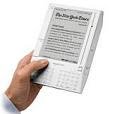
Photo Credit: Wired.com
Apple Tablet Challenge to Kindle Delayed, It's Said

This is an UPDATE to the long story a couple of days ago about AllthingsD's earlier report that the Apple tablet might be announced the week of Sept. 7 at one of their keynote events.

Today AllthingsD is reporting (John Paczkowski) that the keynote event will be Sept. 9 in San Francisco but that
"...our sources insist it will not involve any discussion whatsoever of the tablet Apple is reportedly developing.   Too bad. It’s looking more and more like we’ll have to wait until 2010 for that."
  Instead, the event "is expected to showcase upgrades to the iPod line and an update to iTunes that may involve some sort of social element."

  Interestingly, the over-rumored Apple Tablet or iPad has been described AS an "upgrade to the iPod line" -- larger ones.  I imagine getting all the contract negotiations with publishers and cellular phone companies would have presented a problem for early delivery even if the rumored unit was almost ready.  Or maybe Apple is playing it coy, as it has before.

  Remaining excitement could be an appearance by Steve Jobs.  Here's a fascinating article on Jobs and on Apple itself by The Sunday Times, August 16, 2009.

  Additional reading for the interested:
  Two Apple tablets - Slashgear